
Why a small pension top-up today can boost your retirement income for decades
Learn how a small monthly pension top-up in your 30s, 40s or 50s could boost your retirement income for decades.


It’s hard to imagine yourself 10, 20 or even 30 years older. But, in time, you’ll reach the stage when you’ll no longer work. And how much you enjoy your retirement will, in part, depend on how much money you have in your pension pot.
The good news is that there are small steps you can take now that could transform how you spend your retirement.
A little bit often wins the race
Making regular small payments can make a big difference to your pension in the long run.
This is because when you invest, you not only earn returns on the money you pay in, but also on the returns themselves. So if, for example, you invest £1,000, and gain £50, you’ll start earning returns on £1,050. And so it continues. This is called compounding.
The tax perk of paying into a pension
You not only have the benefit of compounding on your side. When you pay into a pension, you also receive tax relief, which can boost your pension pot too.
For example, when you pay into a self-invested personal pension (SIPP), like the one Vanguard offers, you automatically get 20% tax relief from the government. So, for every £80 you pay in, you get £20 in tax relief on top. If you’re a higher-rate or additional-rate taxpayer, you can claim a further £20 or £25, respectively, through your tax return.
How a small top-up can boost your pension income
It’s easy to underestimate how much you need to pay into your pension to have a comfortable retirement.
If you’re employed, you’re likely to be in an auto-enrolment pension scheme. This means that if you’re eligible for a workplace pension, your employer will automatically add you to their scheme.
You pay a minimum of 5% of your qualifying earnings and your employer pays a minimum of 3%1.
You could well assume that you’ve got your retirement covered. But this 8% total contribution may not be enough to give you the lifestyle you want when you finally retire.
And how much you need in your pension pot for a comfortable retirement may not be the only thing you underestimate. Many underestimate how long they’ll live. This mix can make a pension shortfall even bigger.
The good news is that there’s something simple you can do now to improve your financial future. Making small, regular top-ups to your pension can make a meaningful difference to how much money you’ll have to enjoy your later years. We’ve crunched some numbers to show you.
If you start your top-up aged 30
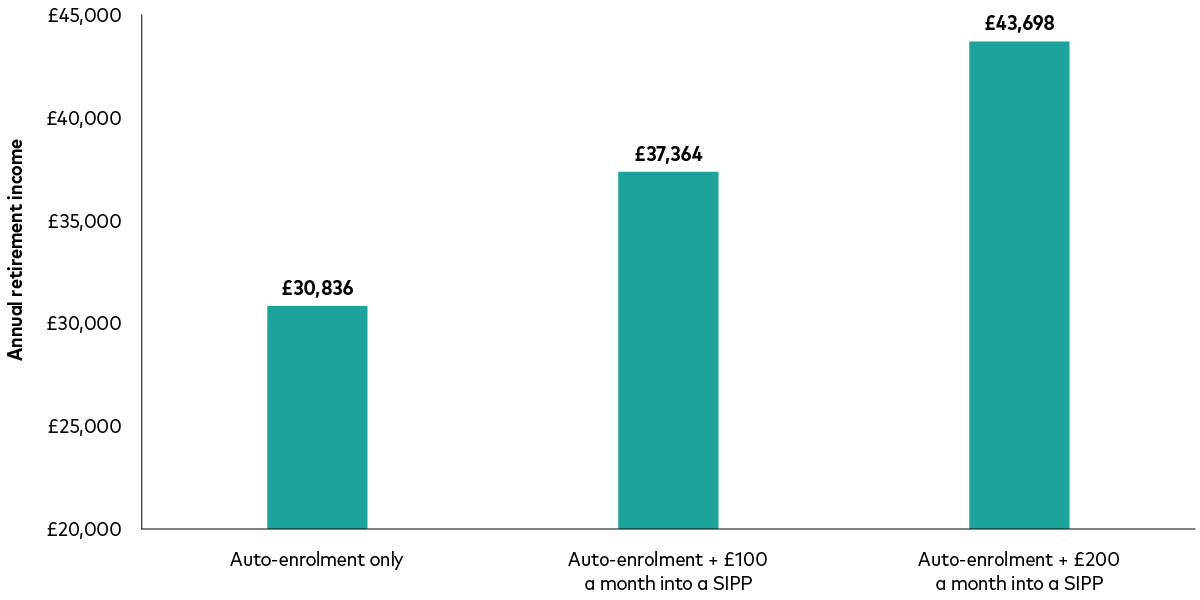
The chart below shows the annual income a 30-year-old could expect to receive in retirement based on three different scenarios: just paying the minimum auto-enrolment payment into their workplace pension; saving an extra £100 a month into a SIPP; and saving an extra £200 a month into a SIPP.
We’ve assumed they:
- earn £30,000 a year
- already have £20,000 in their workplace pension
- retire at 68 with a full State Pension
If they rely on auto-enrolment alone, their pot would be worth £442,358 when they retire, based on an annual return of 5% after fees. This would give them an estimated annual retirement income of £30,836 after tax (including the State Pension) until age 100.
But look what happens if they pay £100 a month into a SIPP. Their pension pot would swell to £603,922 and their annual retirement income would rise to an estimated £37,364 after tax. That’s an extra £6,500 to spend on things like holidays or meals out every single year.
And it gets better. If they double their SIPP payments to £200 a month, their pension pot balloons to £765,487, giving them an annual retirement income of around £43,698 after tax. That's almost an extra £13,000 a year compared to just paying the minimum auto-enrolment payment. You could buy a new kitchen or car for that.
Projected retirement income for a 30-year-old retiring at age 68
Notes: These hypothetical scenarios are for illustrative purposes only and do not represent a particular investment or its expected returns. Your pension income will depend on future returns, charges and contributions. The monthly contribution of £100 into a SIPP is boosted to £125 by basic-rate tax relief and the £200 contribution is boosted to £250. The calculations assume the individual earns £30,000 a year and already has £20,000 in their pension. Their salary and the auto-enrolment thresholds rise by 3% a year. Annual retirement income is based on the individual living to age 100 and is shown after tax. It includes the full State Pension, which rises by 2.5% a year. It assumes the individual increases their pension withdrawals by 2% a year and 25% of each withdrawal is tax free. The money in the pension grows by 5% a year after fees.
Source: Vanguard, February 2026.
If you start your top-up aged 40
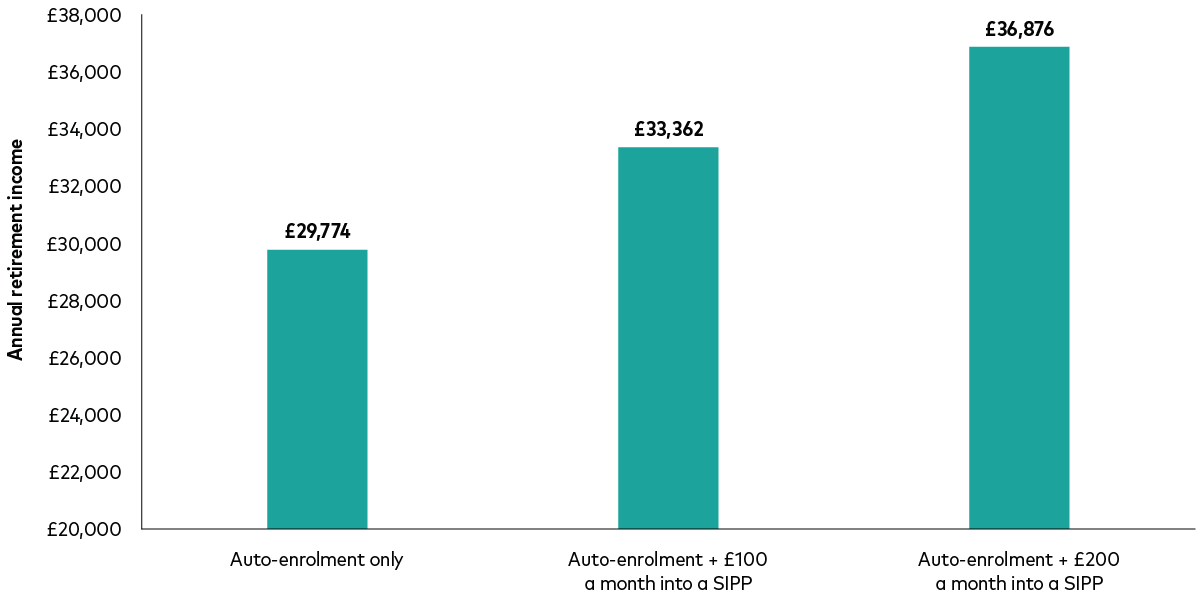
The chart below shows the annual income a 40-year-old could expect to receive in retirement based on three different scenarios: just paying the minimum auto-enrolment payment into their workplace pension; saving an extra £100 a month into a SIPP; and saving an extra £200 a month into a SIPP.
We’ve assumed they:
- earn £40,000 a year
- already have £50,000 in their workplace pension
- retire at 68 with a full State Pension
If they rely on auto-enrolment alone, their pot would be worth £416,419 when they retire, based on an annual return of 5% after fees. This would give them an estimated annual retirement income of £29,774 after tax (including the State Pension) until age 100. That’s about £10,000 less than they earn now.
But if they pay £100 a month into a SIPP, their pension pot would be £504,023 and they’d receive an annual retirement income of about £33,362 a year after tax. That’s £3,500 a year more compared to just paying the minimum auto-enrolment pension payment.
And if they boost their SIPP payments to £200 a month, their pension pot grows to £591,627. That would give them an estimated annual retirement income of £36,876 after tax, which is £7,000 a year more compared to just paying the minimum auto-enrolment pension payment. That's several fancy holidays a year.
Projected retirement income for a 40-year-old retiring at age 68
Notes: These hypothetical scenarios are for illustrative purposes only and do not represent a particular investment or its expected returns. Your pension income will depend on future returns, charges and contributions. The monthly contribution of £100 into a SIPP is boosted to £125 by basic-rate tax relief and the £200 contribution is boosted to £250.The calculations assume the individual earns £40,000 a year and already has £50,000 in their pension. Their salary and the auto-enrolment thresholds rise by 3% a year. Annual retirement income is based on the individual living to age 100 and is shown after tax. It includes the full State Pension, which rises by 2.5% a year. It assumes the individual increases their pension withdrawals by 2% a year and 25% of each withdrawal is tax free. The money in the pension grows by 5% a year after fees.
Source: Vanguard, February 2026.
If you start your top-up aged 50
Even if you’re nearer retirement, and have less time for your money to grow, making monthly top-ups into a SIPP can make a meaningful difference to your later years.
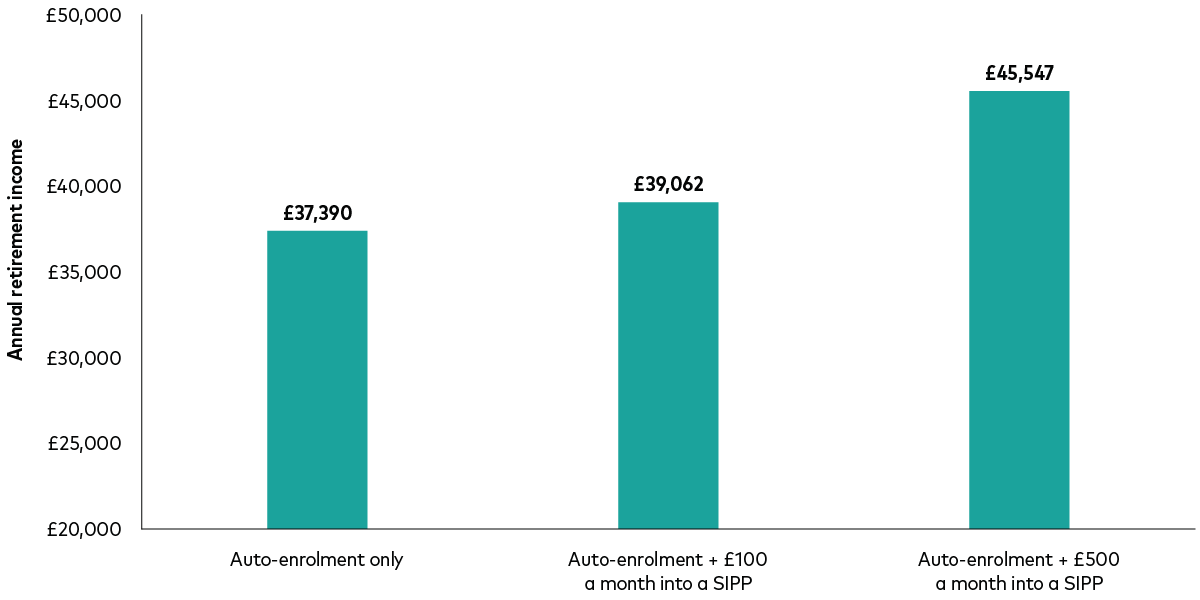
The chart below shows the annual income a 50-year-old could expect to receive in retirement based on three different scenarios: just paying the minimum auto-enrolment payment into their workplace pension; saving an extra £100 a month into a SIPP; and saving an extra £500 a month into a SIPP.
We’ve assumed they:
- earn £50,000 a year
- already have £200,000 in their workplace pension
- retire at 68 with a full State Pension
If they rely on auto-enrolment alone, their pot would be worth £604,585 when they retire, based on an annual return of 5% after fees. This would give them an estimated annual retirement income of £37,390 after tax (including the State Pension) until age 100.
If they pay an extra £100 a month into a SIPP, their pension pot would be £646,783 when they retire. This would give them an estimated annual retirement income of £39,062 after tax. That's only £1,672 a year more, so not much difference.
But if they start paying £500 a month into a SIPP, which they may well be able to afford if they’ve paid off their mortgage, their pension pot would balloon to £815,577.
This means their annual retirement income would rise to around £45,547 after tax. That's about £8,000 a year more compared to just paying the minimum auto-enrolment payment. It’s a nice sum to enjoy yourself with when time is finally your own.
Projected retirement income for a 50-year-old retiring at age 68
Notes: These hypothetical scenarios are for illustrative purposes only and do not represent a particular investment or its expected returns. Your pension income will depend on future returns, charges and contributions. The monthly contribution of £100 into a SIPP is boosted to £125 by basic-rate tax relief and the £500 contribution is boosted to £625. The calculations assume the individual earns £50,000 a year and already has £200,000 in their pension. Their salary and the auto-enrolment thresholds rise by 3% a year. Annual retirement income is based on the individual living to age 100 and is shown after tax. It includes the full State Pension, which rises by 2.5% a year. It assumes the individual increases their pension withdrawals by 2% a year and 25% of each withdrawal is tax free. The money in the pension grows by 5% a year after fees.
Source: Vanguard, February 2026.
Embrace the power of now
As we’ve seen, saving an extra £100, £200 or £500 each month, on top of an auto-enrolment pension payment, could make a significant difference to how much money you have in retirement.
And the sooner you start your small top-ups, the more you’re likely to gain, as your money will have more time to grow.
Once you’ve set up a Direct Debit to pay a monthly top-up into a SIPP, there’s nothing more to do. You can just sit back, knowing you’ve taken steps towards a more comfortable financial future.
1 The auto-enrolment minimum contribution for the tax year 2025-26 is 8% of your salary between £6,420 and £50,270. The 8% comprises 5% from you (including tax relief) and 3% from your employer.

Investment risk information
The value of investments, and the income from them, may fall or rise and investors may get back less than they invested.
Any projections should be regarded as hypothetical in nature and do not reflect or guarantee future results.
Eligibility to invest in a Vanguard Personal Pension depends on your individual circumstances. Please be aware that pension and tax rules may change in the future and the value of investments can go down as well as up, so you might get back less than you invested. You cannot usually access your pension savings or make any withdrawals until the age of 55, rising to the age of 57 in 2028.
If you are not sure of the suitability or appropriateness of any investment, product or service you should consult an authorised financial adviser. Please note this may incur a charge.
Any tax reliefs referred to are those available under current legislation, which may change, and their availability and value will depend on your individual circumstances. If you have questions relating to your specific tax situation, please contact your tax adviser.
Important information
Vanguard only gives information on products and services and does not give investment advice based on individual circumstances. If you have any questions related to your investment decision or the suitability or appropriateness for you of the product[s] described, please contact your financial adviser.
This is designed for use by, and is directed only at persons resident in the UK.
The information contained herein is not to be regarded as an offer to buy or sell or the solicitation of any offer to buy or sell securities in any jurisdiction where such an offer or solicitation is against the law, or to anyone to whom it is unlawful to make such an offer or solicitation, or if the person making the offer or solicitation is not qualified to do so. The information does not constitute legal, tax, or investment advice. You must not, therefore, rely on it when making any investment decisions.
Issued by Vanguard Asset Management Limited, which is authorised and regulated in the UK by the Financial Conduct Authority.
© 2026 Vanguard Asset Management Limited. All rights reserved.
5206844