
What is ‘bed and ISA’ and ‘bed and pension’?
‘Bed and ISA’ or ‘bed and pension’ means moving investments from a general account to an ISA or pension. We discuss how it works and whether it’s worth doing.

Do you have investments outside an ISA or pension? If you have unused allowances, you may be able to move some of them into a more tax-efficient account. That’s where ‘bed and ISA’ and ‘bed and pension’ come in.
The names may sound unusual, but the idea is relatively simple: both can help you shield more of your investments from tax.
Here, we explain how they work, when they might make sense and the potential drawbacks to be aware of.
What is bed and ISA?
Bed and ISA is when you move investments from your general account to an individual savings account (ISA).
The reason for doing so is that ISAs let your investments grow free from tax. This includes the income tax you might pay on the dividends1 or interest you receive, as well as the capital gains tax (CGT) that could be applied on any gains you make when selling investments.
With a general account, you’ll pay tax on any dividends, interest or profits that exceed your tax-free allowances. By moving your investments to an ISA, you can reduce or even eliminate these potential tax liabilities.
How does bed and ISA work?
It isn’t possible to transfer investments directly from a general account to an ISA, which is where bed and ISA comes in. Bed and ISA is a two-step process which involves selling holdings in your general account and then buying back the same holdings within your ISA (or other holdings if you do want to make a change).
Find out how to carry out a bed and ISA transaction with Vanguard.
Bed and ISA benefits
If you haven’t already used up your £20,000 ISA allowance – or aren’t intending to do so with new savings – bed and ISA could be well worth considering.
When you initially sell holdings in your general account, you’ll be liable to tax on profits that exceed your annual £3,000 CGT allowance. However, over time, this cost could be outweighed by the future tax savings from holding your investments in an ISA.
Imagine two higher-rate taxpayers who each start with £100,000 in a general account and £100,000 in an ISA.
The only difference is what they do next.
Investor A uses bed and ISA
Using their £20,000 allowance, Investor A gradually sells investments and moves the proceeds from their general account into their ISA each year until their general account is empty.
Investor B does nothing
Investor B leaves the original £100,000 in their general account throughout.
Assuming both portfolios grow by 5% a year after fees, here’s where they stand after 10 years:
Investor A
- All investments are now held within the ISA
- A total of £4,266 in CGT has been paid on the investments sold each year
- No further tax is due when the investments are sold after 10 years
- Proceeds: £334,899
Investor B
- £100,000 remains outside the ISA
- When the investments are sold, they pay 24% CGT on gains above the £3,000 annual exemption
- Proceeds after CGT: £319,126
The result? Investor A ends up £15,773 better off after 10 years, despite holding exactly the same investments!
How bed and ISA can increase returns
Return on a £200,000 original investment over 10 years – using bed and ISA vs doing nothing
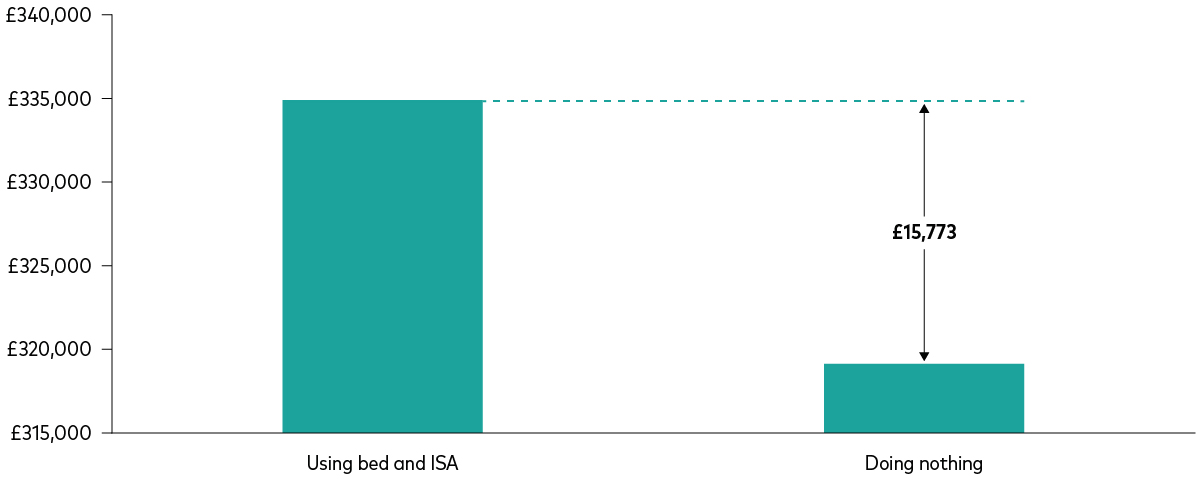
Notes: This hypothetical scenario is for illustrative purposes only and doesn’t represent a particular investment or its expected returns. The investor starts with £200,000 portfolio, split evenly between a general account and an ISA. The portfolio is made up of 75% shares and 25% bonds and returns 5% a year after fees. Investor A purchases the same holdings within their ISA that they held within their general account, paying any CGT due each year. Investor A and Investor B sell all of their investments at the end of the final year. The calculations assume the investor is a higher-rate taxpayer and use the tax rates and allowances that will apply from 6 April 2027.
Source: Vanguard calculations.
Bed and ISA drawbacks
Bed and ISA counts towards your ISA allowance, so you need to make sure the transactions – plus any contributions you’ve already made this tax year – don’t exceed the current £20,000 annual limit.
As mentioned before, selling investments in a general account could trigger CGT. Over time, this will hopefully be outweighed by the impact of future tax-free growth, but that isn’t guaranteed.
When you sell and re-buy investments, you’ll also be out of the market for a period of time. During that time, the price of the investments might change, so you could end up with fewer units or shares in your ISA than you originally held.
Selling funds in your general account and then transferring the proceeds to your ISA can take a few days to complete, so it’s best to plan ahead.
What is bed and pension?
It’s also possible to move existing investments into a pension through a similar process known as ‘bed and pension’. You sell holdings in your general account and then buy back the same holdings with your pension2.
Moving investments into a pension not only means future growth will be tax free, but you’ll also get tax relief on the pension contribution.
The main thing to bear in mind with bed and pension is that you can’t access money inside a pension until at least age 55, rising to age 57 from April 2028. You need to be sure you won’t need the money before then.
There are also limits on the amount you can contribute to pensions each year and still get tax relief. In general, this is the lower of £60,000 or your gross relevant earnings3 (including tax relief). For those with higher incomes, the £60,000 may be reduced4. Those without earned income can still contribute £3,600 per year (including tax relief).
Remember, bed and pension transactions will count towards your pension annual allowance. Check how much you and your employer have already contributed to your pension – and consider any further contributions you intend to make this tax year – before going ahead. If you’re not sure, speak to a financial adviser.
Making the most of your money
Whether bed and ISA or bed and pension is right for you will depend on your circumstances, allowances and longer-term goals. But both can help you make more tax-efficient use of investments you already hold, potentially helping your money work harder over time.
1 Dividends are the payments some companies make to their shareholders out of their profits.
2 Please note that with Vanguard, you’ll need to sell holdings in your general account, transfer the proceeds to your bank account, and then use the cash to make a pension contribution. This means the process will take a little longer than with bed and ISA. Make sure you have a verified bank account linked to your Vanguard account for us to make the payment.
3 For more on what counts as ‘relevant earnings’ that can earn tax relief when used to fund a pension, see the HMRC Pensions Tax Manual.
4 To work out if you have a reduced (tapered) annual allowance, see HMRC’s website.

Investment risk information
Investing gives your money the opportunity to grow over time, but market movements mean values can rise and fall along the way.
Any projections should be regarded as hypothetical in nature and do not reflect or guarantee future results.
The eligibility to invest in either ISA or Junior ISA depends on individual circumstances and all tax rules may change in future.
Eligibility to invest in a Vanguard Personal Pension depends on your individual circumstances. Please be aware that pension and tax rules may change in the future and the value of investments can go down as well as up, so you might get back less than you invested. You cannot usually access your pension savings or make any withdrawals until the age of 55, rising to the age of 57 in 2028.
If you are not sure of the suitability or appropriateness of any investment, product or service you should consult an authorised financial adviser. Please note this may incur a charge.
Any tax reliefs referred to are those available under current legislation, which may change, and their availability and value will depend on your individual circumstances. If you have questions relating to your specific tax situation, please contact your tax adviser.
Important information
This is a marketing communication.
Vanguard only gives information on products and services and does not give investment advice based on individual circumstances. If you have any questions related to your investment decision or the suitability or appropriateness for you of the products described, please contact your financial adviser.
This is designed for use by, and is directed only at, persons resident in the UK.
The information contained herein is not to be regarded as an offer to buy or sell or the solicitation of any offer to buy or sell securities in any jurisdiction where such an offer or solicitation is against the law, or to anyone to whom it is unlawful to make such an offer or solicitation, or if the person making the offer or solicitation is not qualified to do so. The information does not constitute legal, tax, or investment advice. You must not, therefore, rely on it when making any investment decisions.
Issued by Vanguard Asset Management Limited, which is authorised and regulated in the UK by the Financial Conduct Authority.
© 2026 Vanguard Asset Management Limited. All rights reserved.
6095631